Student Work
Shuti Tina Xu: NOT YOUR FRIEND (2025)In September 2025, the AI companionship service Friend.com launched a large-scale subway advertising campaign across New York City. The posters, printed in soft pink tones and gentle copywriting, encouraged riders to “be friends with AI.” Although the campaign appeared to offer comfort and emotional support to those experiencing loneliness, the posters were quickly written over, defaced, and reinterpreted through public graffiti. Messages such as “AI IS NOT YOUR FRIEND,” “STOP CAPITALIZING ON LONELINESS,” and “MAKE FRIENDS WITH SOMETHING ALIVE” emerged—not as acts of simple vandalism, but as collective responses to the commodification of emotional experience. I documented this phenomenon through both field photography and publicly shared online images, forming a visual archive of human reactions and counter-voices.
Based on this collected material, I created this zine. NOT YOUR FRIEND is printed in black and white, in a 1/4 letter format, with a black border and page numbering that echoes the proportions of subway poster frames. The typography combines digital sans-serif type with scanned handwritten marks, creating a direct contrast between algorithmic language and human trace. The zine is structured in six thematic sections: beginning with the question “What is the opposite of AI?” and progressing through themes of loneliness-as-commodity, surveillance disguised as intimacy, environmental cost, public resistance, and, finally, the question of what it means to remain human.
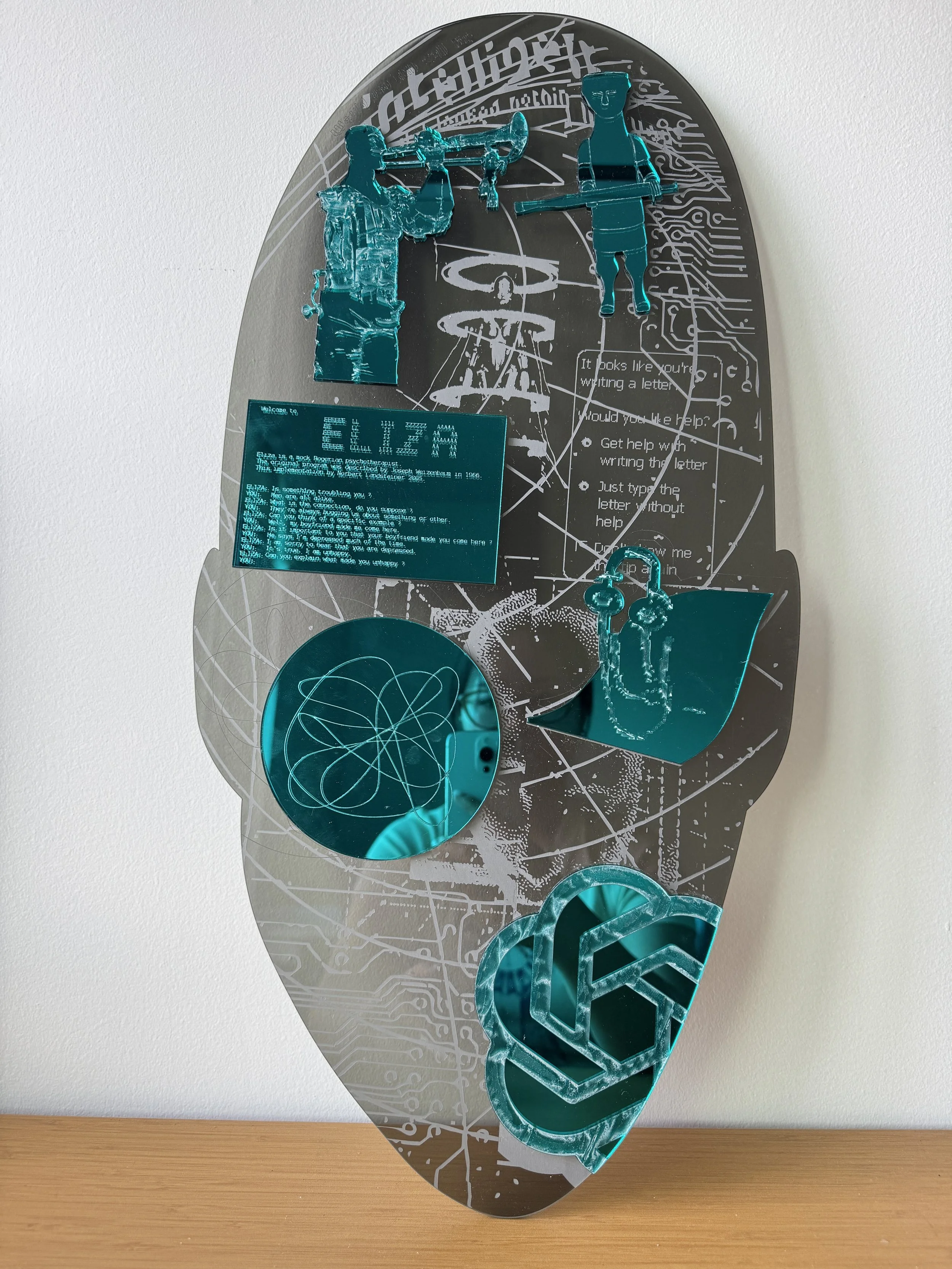
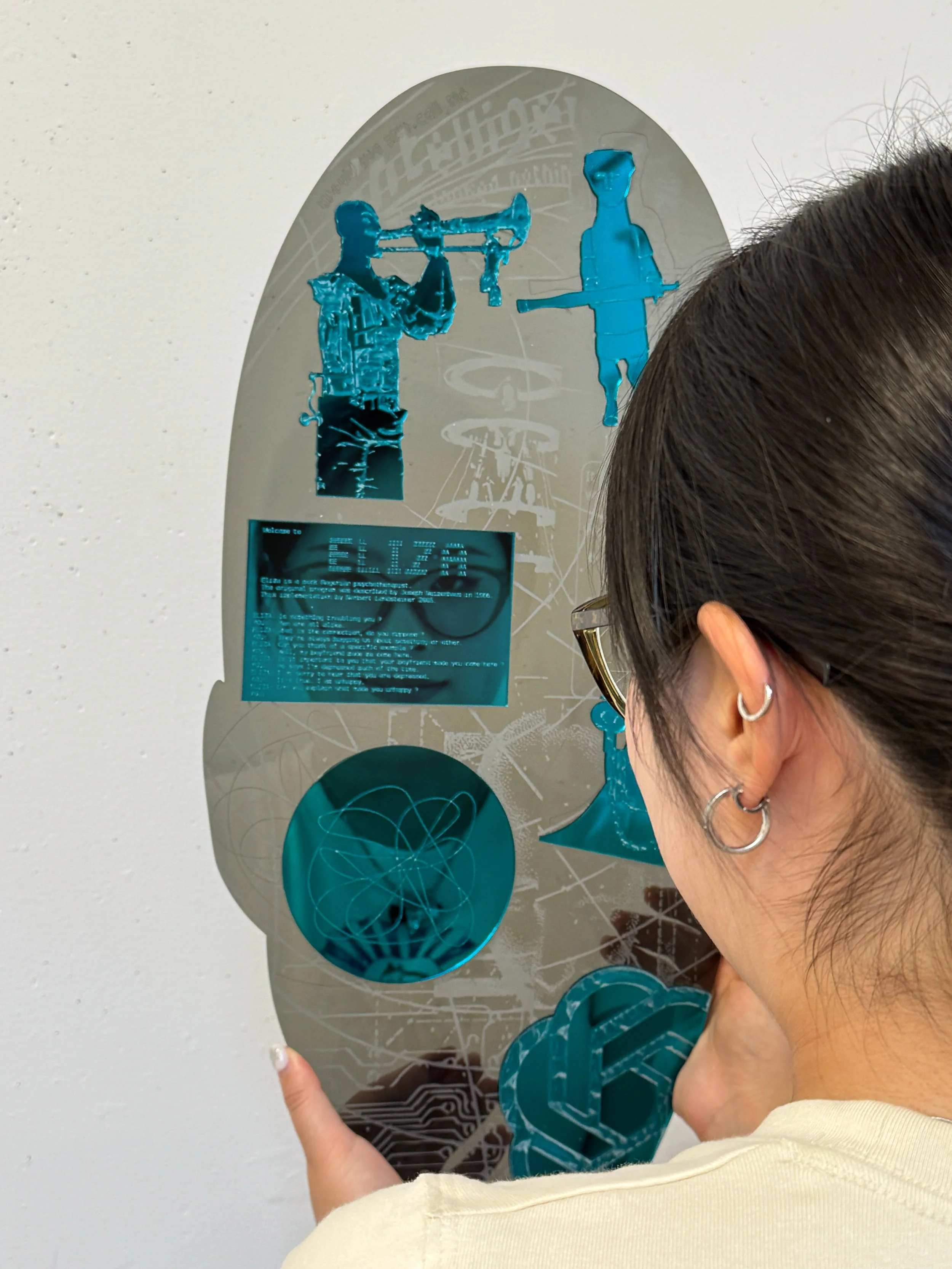
Shuti Tina Xu: AI Simulated Emotion and Anthropomorphic Design (2025)This material artifact is a laser-cut acrylic and mirror object in the shape of a human face, serving as both a timeline and a reflective surface. The timeline has visual references to key milestones such as ELIZA, Clippy, Siri, and ChatGPT, etched into acrylic layers that suggest circuits and interfaces. The mirrored forces viewers to confront their own reflection while reading the history, visually embodying the idea that anthropomorphism is a projection of human identity onto technology.
Huixin Nora Wang: I’M NOT A TYPO (2025)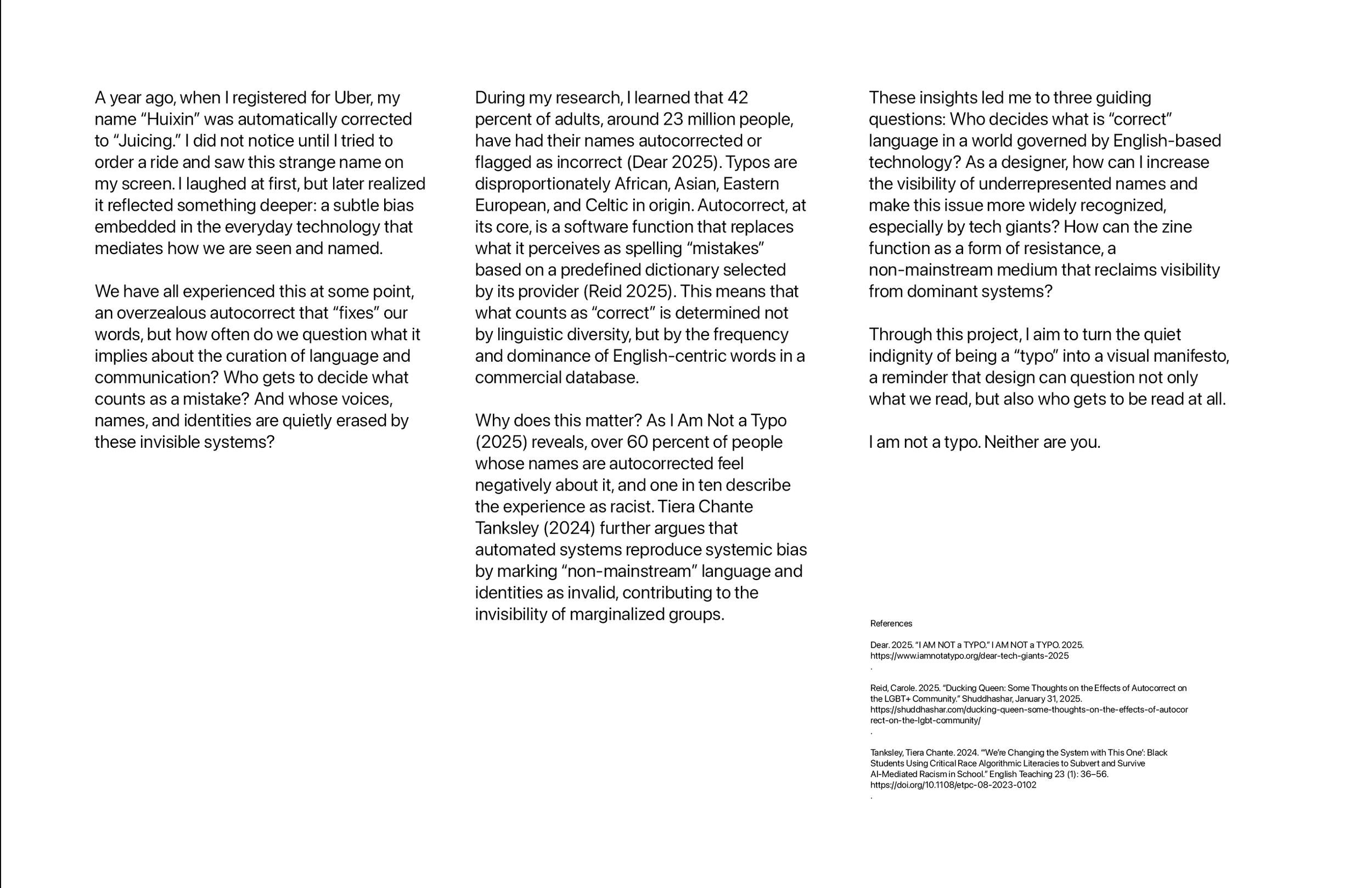
Byron Campos: Tote Bag as Interaction Design Challenge (2026)Jenelle Zhao: Gaze as a Language (2025)Gaze as a Language is an interactive prototype that explores how emerging technology can create more intimate and emotionally resonant interactions. Instead of using eye tracking for productivity, surveillance, or identification, this project shifts attention toward quiet communication. It transforms subtle eye movements into a personal, poetic message addressed to someone meaningful in the user's life.
This project began with a question: what if gaze could be treated as a language, rather than a biometric marker? Unlike spoken words or recorded gestures, the messages carried by the eyes are fleeting and difficult to archive. Yet these small, almost invisible forms of communication often carry great emotional weight. By recording and reinterpreting them, the prototype gives form to something that usually disappears.
The project was developed using a range of AI tools. Initial concept writing and prototype logic were created in collaboration with ChatGPT. Visual structure and camera input were tested in Figma Make. Additional refinements were explored through Gemini 3. While these platforms are highly technical, the project emphasizes emotional and symbolic outcomes rather than data precision.